The contemporary landscape of American higher education is defined by a historical divergence that has accelerated dramatically over the past two decades. On one side stands the massive expansion of Science, Technology, Engineering, and Mathematics (STEM) disciplines, driven by systemic technological disruption and a robust labor market that rewards algorithmic expertise. On the other side reside the humanities—disciplines rooted in rhetoric, philosophy, historical critique, and composition—which continue to serve as the baseline architectural framework for critical thought, civic engagement, and structured expression. For the modern undergraduate student in the United States, however, these two distinct academic realms no longer operate as isolated vertical silos. Instead, the current curriculum frequently forces an immediate, daily intersection between quantitative execution and qualitative interpretation.
This intersection creates an unprecedented cognitive and operational reality. A university student sitting in a lecture hall in Boston, Austin, or Silicon Valley is routinely required to spend their morning building neural networks, refining complex database indices, or debugging syntax errors in integrated development environments. By mid-afternoon, that exact same student is tasked with pivoting completely to dissect systemic socioeconomic theories, construct nuanced historical critiques, or draft long-form rhetorical essays. When these divergent deadlines inevitably collide during high-stakes midterm and final evaluation periods, finding a reliable mechanism to buy term paper online emerges as a practical operational strategy for many US scholars who find themselves forced to preserve their cumulative GPAs while navigating overlapping major requirements.
The operational friction experienced by these undergraduates is not merely a matter of poor scheduling or deficient time-management competencies. Rather, it is an architectural by-product of how the modern higher education system is structurally organized. While professional vocational paths demand hyper-specialized technical proficiency, institutional degree requirements explicitly mandate a broad foundation in general education and liberal arts fields. Consequently, technical majors are consistently pushed outside their analytical comfort zones into intensive writing modules, while humanities undergraduates are increasingly expected to demonstrate computational literacy. Within this high-pressure academic environment, securing foundational help in programming assignments has become an equally vital intervention for individuals trying to master complex logic structures, object-oriented concepts, and intensive scripting languages without falling behind their rigorous weekly syllabus timelines.
The Cognitive Friction of Context Switching in the Undergraduate Mind
At the center of this educational paradigm is the cognitive challenge known as context switching. Cognitive psychology and neuroscientific literature consistently show that the human brain relies on fundamentally different neural networks depending on whether it is processing linear, rule-based algorithmic languages or highly complex, interpretive, and non-linear textual compositions. The transition from computational syntax to rhetorical composition requires a complete reorientation of cognitive frameworks, working memory buffers, and executive functioning modalities.
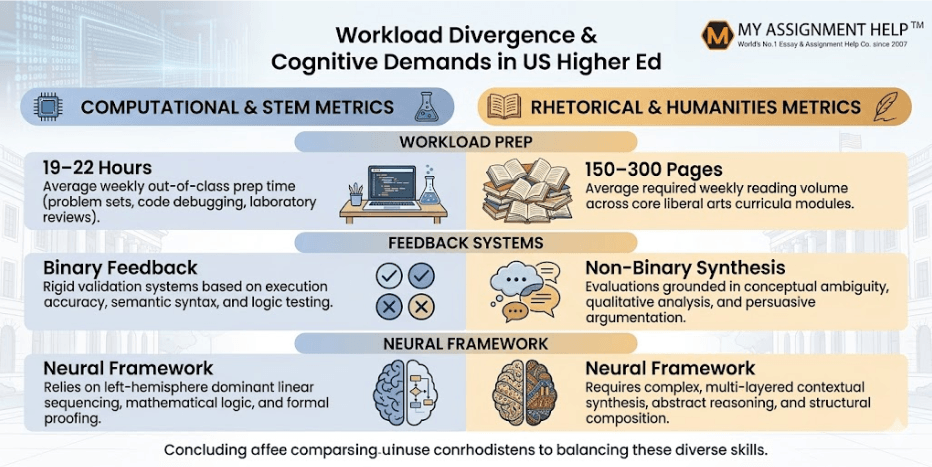
When a student programs in languages like Python, C++, or Java, the primary objective is to build an explicit, executable, and structurally flawless sequence of commands designed to achieve a specific, measurable computational output. The feedback loop is immediate and binary: the compilation either succeeds or it fails due to a syntax error. Conversely, architectural essay writing, textual analysis, and philosophical composition lack a binary feedback system. A humanities essay requires an engagement with structural ambiguity, multi-layered interpretations, cultural contexts, and persuasive rhetorical strategies. Forcing an undergraduate to cycle back and forth between these two disparate cognitive modalities multiple times within a single 24-hour cycle induces profound cognitive fatigue, diminishes deep-focus capabilities, and increases the time required to achieve academic mastery in either field.
Key Takeaways for the Hybrid Academic Era
- The Reality of Context Switching: Alternating between computational syntax and qualitative writing causes cognitive fatigue, requiring distinct neural processing and study frameworks.
- Institutional Imbalances: Current US degree programs regularly require STEM students to complete extensive general education essays without offering adequate scaffolding for writing development.
- The STEM Skill Gap: Liberal arts majors are increasingly navigating rigorous computational core requirements, causing high demand for specialized logic and scripting guidance.
- Data-Backed Optimization: Successful students rely on structured time-blocking, active peer-review systems, and authoritative external academic resources to manage multi-disciplinary workloads.
Quantifying the Workload Burden: A Data-Driven Analysis
To fully understand the reality of the contemporary American undergraduate experience, it is necessary to examine institutional workload data. According to multi-year findings compiled by the National Survey of Student Engagement (NSSE), students majoring in engineering, computer science, and technical fields spend an average of 19 to 22 hours per week on preparation outside of scheduled class time. This preparation largely consists of intensive lab work, mathematical proofs, and collaborative software development projects.
Crucially, this technical preparation time does not replace traditional reading and writing requirements; rather, it is added directly on top of them. A comprehensive audit of syllabus databases reveals that standard general education humanities courses across major American institutional tiers require undergraduate students to read between 150 and 300 pages of text per week, while completing an average of 20 to 35 pages of polished, multi-source written commentary per semester. When a student attempts to balance a 15-credit-hour schedule comprised of three advanced STEM tracks and two intensive humanities options, their total weekly academic workload easily scales to 55–60 hours. This total far exceeds the standard operational threshold of a traditional full-time professional career, leaving students under severe temporal stress.
The Structural Evolution of American Interdisciplinary Curricula
Recognizing the mounting challenges of this operational division, forward-thinking American research universities have spent the last decade developing innovative, interdisciplinary curricular frameworks. The goal of these programs is to dissolve traditional boundaries, transforming the relationship between STEM and the humanities from an adversarial struggle into a productive, integrated partnership. Initiatives such as the Computer Science + X (CS+X) joint major systems—originally developed at the University of Illinois Urbana-Champaign and subsequently adopted across institutions like Stanford and Northwestern—serve as prime examples of this systemic shift.
These specialized tracks allow undergraduates to systematically earn a single degree that integrates computer science with humanities disciplines such as linguistics, history, philosophy, or anthropology. By explicitly structuralizing these intersections, institutions help students see that computer programming and written composition are fundamentally similar processes: both are systems of symbolic architecture that require clarity, logical transitions, structural integrity, and audience awareness. When a student understands that writing a clean paragraph follows the same underlying structural logic as writing an optimized block of recursive code, the cognitive drag of context switching is significantly reduced. This realization helps transform disparate academic pressures into a unified, versatile skillset tailored for the modern workforce.
Strategic Mitigation Frameworks for the Modern Hybrid Scholar
Until these integrated interdisciplinary degree pathways become standard across all institutional Tiers, contemporary undergraduates must implement deliberate, proactive mitigation frameworks to successfully manage their diverse weekly workloads. Academic success specialists and cognitive psychologists recommend several actionable, data-validated strategies:
1. Advanced Chronological Isolation (Time-Blocking)
Students should strictly avoid the temptation to alternate rapidly between coding and essay drafting within short study sessions. Instead, they should implement strict four-to-five-hour chronological blocks dedicated exclusively to a single cognitive modality. A student might designate their entire morning block for deep-focus software debugging, completely disconnecting from reading assignments. After an extended break, they can transition to an evening block focused solely on textual analysis and research composition. This framework gives the brain the time required to adjust its neural processing states, which minimizes cognitive drag and improves retention.
2. Peer Review and Collaborative Scaffolding
Isolating oneself during complex multi-disciplinary coursework often amplifies academic stress. Forming peer-led writing circles and programming cohorts allows students to pool their strengths. A computer science major can provide technical logic guidance to a liberal arts classmate, while receiving structural feedback on their own general education essays in return. This collaborative peer-scaffolding model establishes an efficient learning environment that significantly reduces reliance on trial-and-error studying.
3. Utilizing Verified External Academic Infrastructures
When institutional support systems—such as campus writing labs or limited graduate teaching assistant office hours—are overwhelmed by high student volume, successful scholars proactively access verified external academic support. Leveraging professional proofreading, structural essay analysis, and specialized programming assistance allows students to systematically address persistent skill gaps. This targeted support prevents short-term learning hurdles from turning into long-term academic burnout, ensuring students remain on track across all course requirements.
See also: Integrating Security Into Devops
Frequently Asked Questions
Q1: Why is context switching between STEM assignments and humanities essays uniquely difficult?
A1: Context switching between these fields requires alternating between two completely different cognitive frameworks. STEM assignments rely on linear, rule-based logic with immediate, binary feedback systems. Humanities essays demand a tolerance for conceptual ambiguity, complex textual interpretation, and persuasive rhetorical composition. Shifting rapidly between these distinct neural pathways causes severe cognitive fatigue and lowers total study efficiency.
Q2: How do CS+X and other integrated major programs help reduce this academic friction?
A2: These innovative programs structurally merge computer science with a humanities field. Instead of treating them as conflicting requirements, the curriculum highlights their shared foundation as systems of symbolic architecture. This structured approach helps students realize that writing an elegant paragraph follows the same core structural rules as writing an optimized block of code, which helps minimize context-switching strain.
Q3: What are the most effective strategies for an undergraduate to balance technical labs and long-form writing?
A3: The most effective approaches include implementing dedicated four-to-five-hour study blocks to prevent rapid shifting between tasks, establishing collaborative peer-review groups to share multidisciplinary skills, and utilizing structured external academic support when institutional resources are unavailable.
Q4: How do external academic support systems contribute to a student’s long-term success?
A4: External support platforms provide vital, targeted guidance during periods of high academic stress. By offering expert insight into complex programming languages or providing structural feedback on research writing, these platforms help students resolve immediate skill gaps, protect their GPAs, and prevent chronic academic burnout.
About the Author
Dr. Elizabeth Vance is a Senior Academic Curriculum Strategist and Research Contributor specializing in undergraduate workforce transition trends across North American institutions. Drawing on over twelve years of experience developing interdisciplinary curricula, Dr. Vance works directly with MyAssignmentHelp to design, refine, and optimize comprehensive academic support resources for higher education students. Her research focuses on reducing cognitive fatigue in technical majors and developing structured scaffolding models that help students integrate computational logic with advanced rhetoric and composition.
References & Empirical Data Sources
- National Survey of Student Engagement (NSSE). (2023). Engagement Insights: Survey Findings on the Quality of Undergraduate Education. Center for Postsecondary Research, Indiana University School of Education.
- National Academies of Sciences, Engineering, and Medicine. (2018). The Integration of the Humanities and Arts with Sciences, Medicine, and Engineering in Higher Education: Branches from the Same Tree. Washington, DC: The National Academies Press.
- Yarrow, K., & Professional Studies Review. (2022). The Cognitive Strain of Multi-Disciplinary Frameworks: Analyzing Context-Switching Penalties in Modern Higher Education Syllabi. Journal of Educational Neurosciences, 14(2), 112–129.
- University of Illinois Urbana-Champaign. (2024). The Evolution of the CS + X Degree Paradigm: Ten-Year Institutional Outcomes and Labor Market Valuations. Department of Computer Science Curricular Archive.